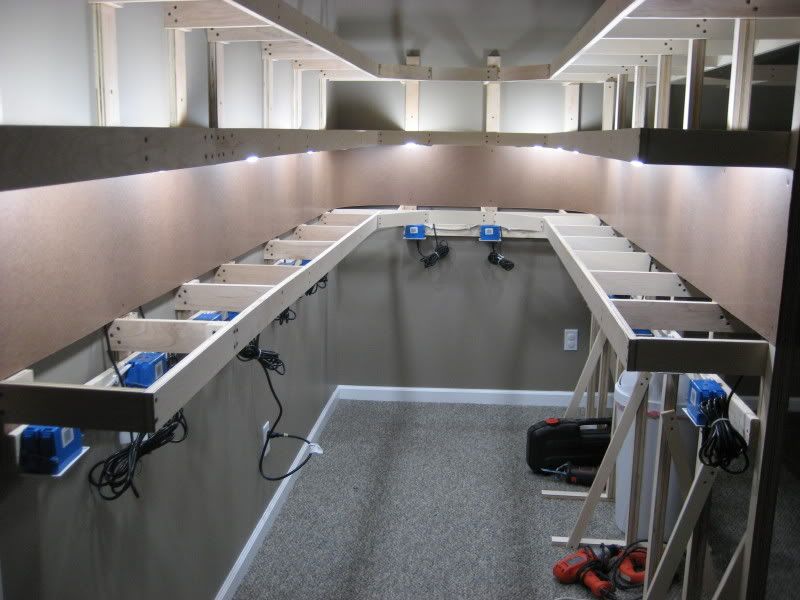
Everything looked pretty good, except for some dark areas towards the upper part of the backdrop in a few spots. This was happening because some of the lights were installed immediately adjacent to a joist, which was basically blocking the light from the top part of the backdrop on the opposite side of the joist from the light. To solve this problem, I simply rotated the entire light fixture so that the bulb would be moved down below the bottom of the joist. This placement of the fixture resulted in much more even lighting on the backdrop. Here is a view of one of the fixtures from behind showing how the bulb has been rotated downward:
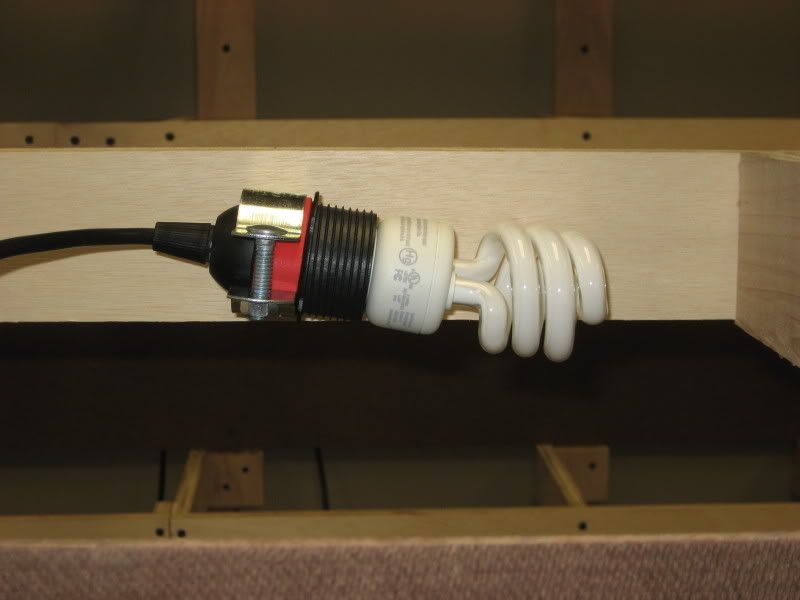
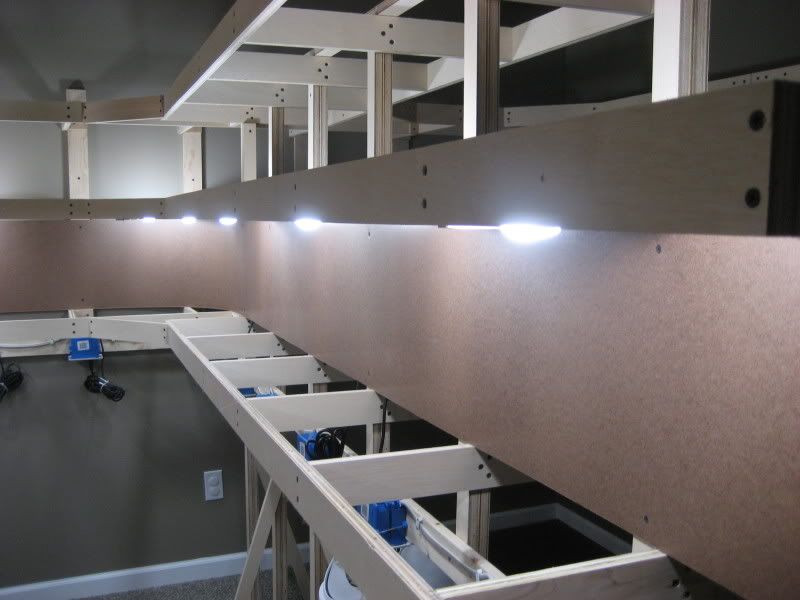
Here is the same fixture viewed from the front (from the aisle). You can see how part of the bulb is below the bottom of the joists and the front boards allowing light to reach the upper part of the backdrop. The bulb will not be visible from the front once the fascia boards have been installed:
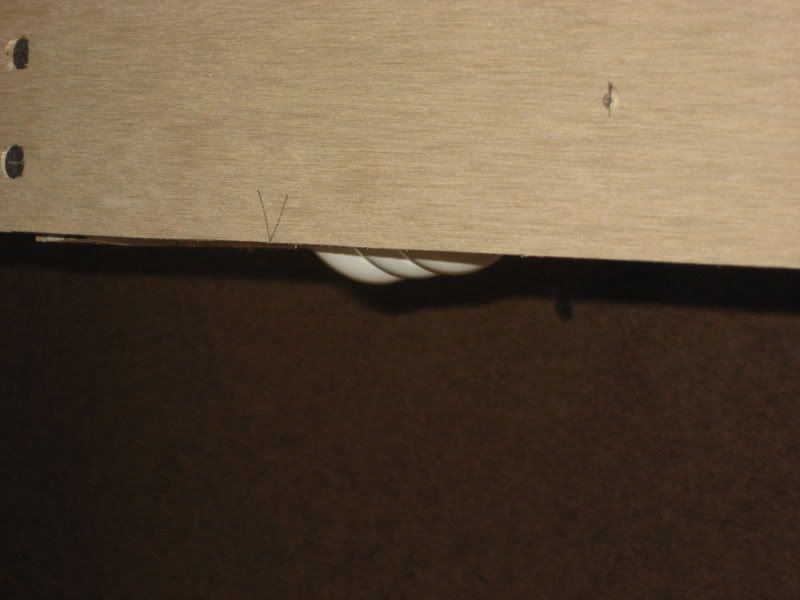
Here is a low level view of the same area with the layout lights turned on and the room lights turned off. You can again see how the lights "peek" below the benchwork and provide even lighting on the backdrop. Again, the lights will be blocked on the front of the layout once the fascia boards are installed. Note: Although there appears to be some dark areas in the backdrop in this photo (and others), this is mostly due to color irregularities in the 1/8" Masonite panels; not dark spots due to improper lighting:
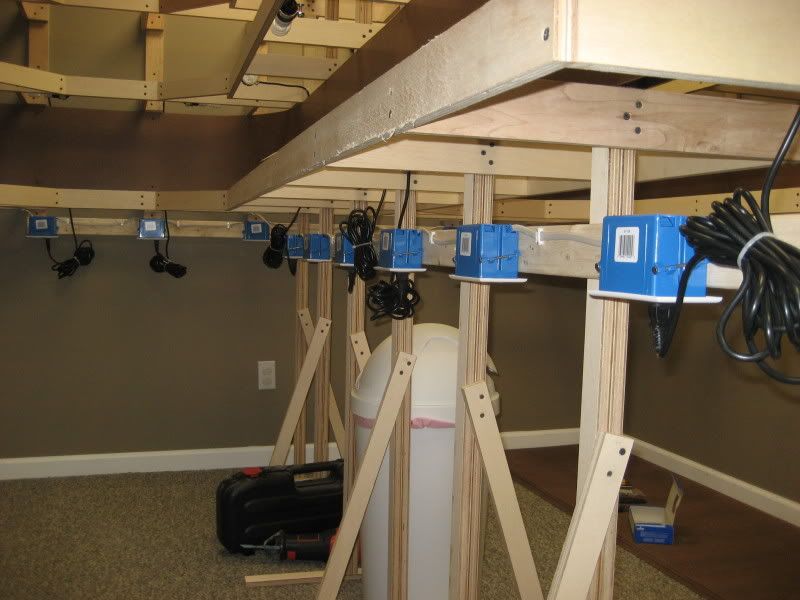
Here is a view of the finished "power strip" that distributes 120v power down the layout peninsula. The outlets and coiled up bundles of cords will be hidden by the skirting that will eventually be installed:
About halfway through installing the lighting shown in the above pictures, I started to realize that I was not happy with the color or brightness of the bulbs I had selected. For some reason, I thought I had read that most modelers preferred the "soft white" CFLs, so I selected the following 40-watt CFL bulbs readily available at The Home Depot:
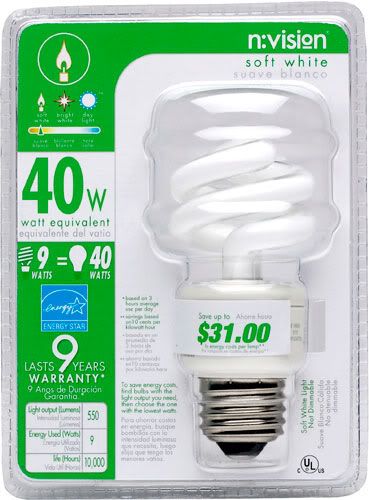
However, I found the light emitted by these bulbs to be far too yellow for my liking. Also, they did not seem bright enough. I went back and researched lighting on the model railroad forums I visit and realized that just about everyone prefers the "daylight" version of CFLs. I went back to The Home Depot and purchased the 60-watt version of the CFLs as shown here:

Big difference! The light color of the "daylight" bulbs appears cooler and cleaner, and the increased wattage provided the necessary boost needed to get the light level up to acceptable levels. All of the above photos were taken with the 60-watt "daylight" CFLs installed.
.


6 comments:
Great photos and progress report on your lighting. I wanted to ask you about the "power strip" for the 120V circuit.
Did you wire all those outlet boxes attached to the benchwork directly to the electric supply?
Ryan, The boxes are hardwired to each other. The first box on the strip contains a light switch. One side of the light switch is attached to a cord with a plug that just plugs into a regular 3 prong wall outlet. So while the boxes are hard wired to each other, the whole thing just plugs into any wall outlet in the room. You can see the cord plugged into the wall outlet in the first picture on this post. Jamie
Hi Jamie,
I just came across your blog and have thoroughly enjoyed reading about your progress. I can't wait to see how you complete the helix and get some trains running.
I'm designing a 2, and possibly 3, level N scale layout as well. With a helix of course. The overall layout will be a bit smaller though as my being in an apartment doesn't give me nearly as much space. Not even enough space for either of my 2 HO scale layouts that currently reside at my parents' house. :-(
I'm looking at trying to use LED lighting instead of CFL's. They last about 5 times longer and use even less power. A 19" light bar seems to be at least as bright, or possibly brighter, and uses only 2.0-2.5 watts from a 12v power supply. About 20 or so light bars can be chained together. They produce almost no heat and are very thin (1/4 inch). If 19" is too long, they can be cut in 2 inch increments and the remainder used elsewhere. They do cost a little more, but with longer life and less power, they should pay for themselves rather quickly.
Did you look into LED lighting at all? If so, is there a reason you didn't go with it? If not, would you consider it in the future? After looking into this, it just seems to be a lot less wiring and a lot easier to install. So I thought I would see what your thoughts are.
Fred
I did not consider LEDs because of the cost when compared to CFLs. However, it sounds like what you are considering is very similar to what Tim Horton did with his BC Dawson Creek Subdivision layout. Take a look at the Construction page on hs website:
http://www.bcrdawsonsub.ca/
Also, his layout was just featured in the Model Railroad Planning 2009 that is available right now. Both the website and article discuss the use of LED strips for layout lighting and show photos.
Thank you for your reply Jamie. Both your website and Tim's are very informative. Unfortunately, due to apartment limitations, I can't put brackets into the walls, so my layout will need to be free standing. I was especially interested in the way you did the peninsula, though I am also considering an oval with a cutout in the center for access type method as well.
I now have my own home based business working with computers but I have an electrical engineering background. I first saw a small demonstration of the LED concept at the World's Greatest Hobby on Tour show when it came to the Chicago area in Nov. 1997. Although I had no plans for it at the time, from an EE perspective, I thought it was quite interesting and wish I would have gathered more information about it at the time. The show is in Nashville, TN this weekend, but is a little too far away for me to get to, and there is no way of knowing if they will have a demonstration of this method again either. I'll definitely look at getting the book you mention. It is put out by Model Railroader (Kalmbach Publishing), right?
As an experiment I might try installing the LED lighting under the kitchen cabinets. Another thing that intrigued me was that these lights can also be dimmed. This is something that even you pointed out, is difficult to do with CFL's.
Fred
Hi Jamie,
While at my local Menards store this afternoon I noticed that they now carry dimmable CFL's! They had both 24w (100w equiv.) and 14w (60w equiv.) bulbs. Even better is the fact that they are currently on sale. The lights are manufactured by a company called Neptun Light, Inc. You can also find them on the company's website at www.neptunlight.com. I have no idea just how well they work, but they might be worth testing to see. Since I knew the lack of being dimmable is something you were concerned about with CFL's I thought you might be interested in learning of this news.
Fred
Post a Comment



